I love an article about a filmmaker that starts with:
Hunter Weeks went into his work on the feature documentary “Ride The Divide†with a solid sense of how to get the film out once it was done.
This is so important and yet so overlooked by most filmmakers. It’s a business and you have to think about the Return on Investment right from the start, because you’ll have to be creative about it.
They took on a corporate sponsor and encouraged participants to wear the corporate beanie (but not compulsory). They targeted a limited number of film festivals and when they missed the larger, more public ones, they went straight to distribution.
The film has screened at about 100 times in theaters, in about 70 cities in all, in shows we’ve produced ourselves – sometimes one night, or sometimes three nights in a row in the same place. We also had a licensing fee to screen the film for $295, and we tapped into these hotbed cycling communities – mountain-bike extreme groups all over the country, especially in the mountain region. We had these tremendously successful shows. And that helped sell the DVDs in a pre-release version over the last six months.
One other approach has been to offer 500 “Living Room Screening Packages†for $99, for which 50 percent of the proceeds go to cyclist Lance Armstrong’s Live Strong Foundation. The kit includes a DVD or Bluray in wood laser-engraved box by karvt.com, a limited edition t-shirt byMighty Karma, a SmartWool Beanie, Tony Hsieh’s Best Selling book – Deli
TV is Dead. Long Live Web Video. http://tinyurl.com/2cb9xuu But Web video isn’t television. It’s something else. Web Video abandoned TV.
So much has changed – Cameras, Bandwidth, YouTube – provide a trifecta of change plus the cognitive surplus we have as a result of being less “couch potato” and more “active creator” leads to a whole new thing: not TV, not web video as it’s been.
But Web video isn’t television. It’s something else entirely. And in the past 5 years, from 2005 to 2010, as Web video has moved to become the fastest growing and most prevalent form of traffic emerging on the Web, something else happened.
Web video abandoned TV. It moved on.
There are plenty of examples of this — but the perhaps most dramatic one is the growth of TED Talks. TED Curator, Chris Anderson, calls this emergence Crowd Accelerated Innovation. His thesis is that Web video accelerates the cycle of humans creating, sharing, and iterating.
For years, one of the points we’ve raised in answering the movie industry’s $200 million challenge to us (i.e., “how do you keep making $200 million movies?”) is that, in part, it’s asking the wrong question. No one asks “how do we keep making $10,000 computers?” Instead, they look for ways to make them cheaper (and better, at the same time). But in the world of Hollywood accounting, there’s little incentive to make cheaper movies (sometimes the incentive goes the other way). And, we keep showing how the world is reaching a place where it’s cheaper and cheaper to make good movies. We’ve pointed out nice examples of people making high quality movies for next to nothing. The idea is not that movies should be made for nothing, but that the technology is making it so that movies can be made for less. In fact, with two of the examples of cheap movie making we’ve highlighted, the makers later went on to score deals to do higher end movies for more reasonable budgets.
New research shows that people are abandoning old media by the millions for Internet media. And if they aren’t abandoning it, they are cutting way back on the time the spend with it.
The article then goes on to detail the bad news for cable companies with people cutting basic cable or cutting back to less expensive cable, then it goes on to show how much audience radio is losing among younger people. Interesting background statistics.
In fact, go to any Conference or Seminar where either Scott Kirsner or Peter Broderick are speaking: they’re always interesting.
The event has a couple objectives:
– Let filmmakers connect, find new ways to collaborate, and help one another succeed.
– Talk about what’s changing in terms of funding, distribution, and audience-building, with actual examples and case studies, rather than theoretical predictions.
– Hear directly from filmmakers about what they’ve done successfully with their most recent films to get them seen by a large audience, and earn a solid return. (We also talk about what didn’t work, and wasn’t worth the time or investment.)Â
– Enable participants to sit down with industry experts for small group lunch conversations on very specific topics, like working with the media and bloggers… understanding the way VOD deals work… organizing theatrical screenings that make money… and more.
– Provide ideas and strategies to several filmmakers in the audience, as part of an on-stage brainstorming session.
– Get participants charged up and excited about new possibilities, as opposed to depressed about how things are changing.
This week I had an unplanned trip to Boston to fill in at the Boston FCP User Group meeting for Rich Harrington who’d suffered a back problem and wasn’t able to travel. I travelled American Airlines instead of my normal choice, JetBlue.
That led me to thinking about marketing because of the differences between the two airlines. Let me say up front there was nothing wrong with American. The flight was on time, the crew were ok, the inflight entertainment is a decade out of date (technically and from a marketing perspective) but generally they didn’t do anything wrong.
And yet, I found the whole experience lacking compared with JetBlue. Why I asked myself, and what can I learn from it.
American Airlines is an “old” airline with a long history and tradition, and a lot of old aircraft. JetBlue has outfitted most of its aircraft in the last decade or so, to a uniformly high standard. On JetBlue we get leather instead of 70’s design cloth seats.
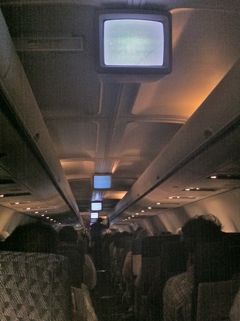
Does this look like an airline that cares about customer experience?
And that’s part of the problem. The cabin was not modern. In fact, it wasn’t well maintaned at all. Seat back pockets were falling off and falling against passengers’ knees. Not one of the six in-cablin screens that I could see were remotely watchable: five of six screens had black levels around IRE 40, one around IRE 20; two had severe magenta shifts and one a blue shift. And so on.
This can’t be a pleasant work environment and, while pleasant enough, there’s a whole different vibe between the cabin crew on American Airlines and the cabin crew on JetBlue. (There was nothing that I felt worth commending anyone on, whereas I’ve had occasion with JetBlue to send in multiple commendations for above-and-beyond service.)
You see, the bottom line is that American only cares about the bottom line. $25 to check the first bag, $35 for the next! Checked baggage makes more available space for in-cabin baggage and you’d think they’d encourage it. (Here’s a tip. Don’t check your bag unless it cannot fit in in-cabin storage. Take it with you. If there’s not enough space, they’ll gate-check it for you for free, and the gate check is ready when you exit the aircraft unlike the long wait for checked baggage. Just from observation on two flights this week.)
JetBlue think about the whole experience. Just take the in-flight entertainment, for example. On a six hour American Airlines flight we got one movie on the small, ceiling mounted in-cabin CRTs with the affor-mentioned problems, and one NBCU “package” with one TV show and a bunch of short excerpts running about 90 minutes. The other three hours there was no visual entertainment. There were a few audio channels. The movie started more than an hour after leaving the gate. On JetBlue you have a choice of 40 channels of JetBlue on your own seat-back screen, which fills a whole lot more of your field of view than a distant 14″ CRT.  Or your choice of interactive games. Or the whole set of XM Satellite Radio stations. In other words, JetBlue cares about keeping the customers occupied during the flight, with personal choice. An occupied customer is more likely to be  a happy customer.
So if American’s focus is their bottom line, JetBlue’s focus seems to be the customer experience and running an efficient modern fleet makes that easier. But beyond that it’s about how every interaction between customer and company forming the marketing.
When I see a badly maintained cabin, I worry about the rest of the maintenance on the aircraft and wonder if it’s safe to fly with that airline. Logically that doesn’t make sense because there are legally mandated safety standards for the aircraft but none for the cabin, that’s just “marketing”. But people are not logical about things like this. Marketing is always to the emotion not logic.
My takeaway is that it’s no longer enough to just satisfy the customer. I was satisfied with my flights this week, but disappointed because I’ve become used to being “delighted”. Satisfying the customer is no longer enough. You must delight them.
That applies equally to every business transaction that we do; every interaction every single person in a company has with their customers. For example, no-one in any company I control, or in my family will ever fly United Airlines again because of one in-cabin personnel’s totally illegal and out-of-proportion response to my complaint that the light did not light anywhere near the actual seat, like it was supposed to. Her response was to tell me be quiet or I’d be arrested on landing. Totally out of proportion and I would say illegal. I didn’t tell United because a simple Internet search showed that they didn’t care about any customer response. I just withdrew my business. That’s going to cost United $15,000 in the next five years as my mother flies the Pacific twice a year to come visit. She now loves VAustralia.
Marketing is every interaction by every person in your company with every customer.
Since there are currently no available Google TV devices, this advice is somewhat premature, but you might as well file it away for the day you’ll need it.
Personally I’m not sure about where Google TV fits with Apple TV: nerds vs normals?
AppleTV represents a ‘new model only’ (internet+local content streaming), Google TV attempts to skin old tech. That old tech being traditional cable and satellite. It’s middleware to bring legacy tech together.
A longish, but great take on where we are now in independent distribution. Covers topics:
The Landscape
Where we stand
What’s ahead
The New Ground Rules
On licensing in the new ground rules, he’s a realist:
On licensing, if anyone can get your film for free, the only sensible licensing scheme is to distribute with no restrictions on copying and reuse. I realize this rubs some people the wrong way (it used to rub me the wrong way), but in the new era, attempting to enforce all-rights-reserved copyright is a business disadvantage for anyone without a team of lawyers. With no feasible technical approach to stop reproduction and sharing, the only option is to attack legally. That takes lawyers and they are not cheap. Which approach is cost efficient – a market with profits that depend on copyright enforcement via legal channels or the venue that makes money despite unrestricted distribution? If you want to understand the future for copyright licensing, Lawrence Lessig is required reading. He lays it out far better than I ever could, plus his work is of the rare sort that is equally genius, entertaining, and inspiring. Specifically, hit up Remix and Free Culture – pretty sure a couple chapters will convince most anyone. You can buy the books or (Lessig puts his money where is mouth is) download them legally for free here and here.
The World Wide Web Consortium, the body that regulates and publishes the specifications of the HTML standard, is warning web content producers that the HTML5 is “not yet ready for production” and that the W3C will likely make further significant changes to the specification to increase interoperability. Philippe Le Hegaret, interaction domain leader responsible for the HTML and SVG spec, added that they expect it to be feature-complete in mid-2011.
This hasn’t stopped a lot of people already making the move to HTML5 where it makes sense as a Flash (or Silverlight) replacement.